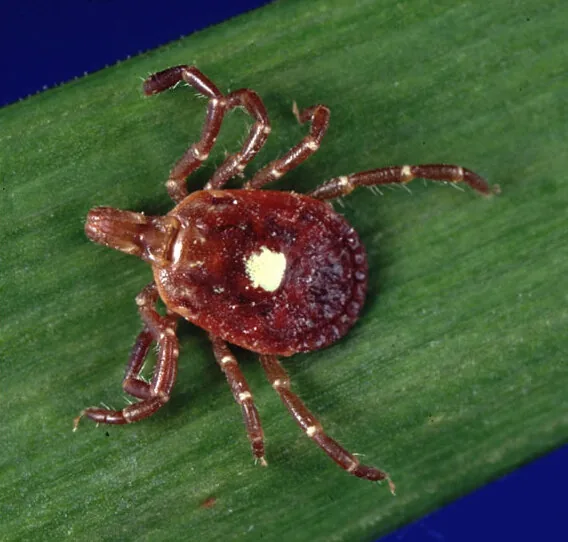
Lone star ticks are aggressive biters found across the eastern and southern United States, and they are spreading north. The adult female carries a single white dot on her back, which is where the name comes from.
Key takeaways
- Lone star ticks are aggressive biters across the eastern and southern United States, and the adult female wears a single white dot on her back.
- They do not carry Lyme disease, but they are linked to ehrlichiosis, STARI, and the alpha-gal red meat allergy.
- The CDC estimates that as many as 450,000 people in the United States may be affected by alpha-gal syndrome.
- Remove an attached tick with fine-tipped tweezers, pull straight out, and watch the bite for several weeks.
- An EPA-registered repellent, 0.5% permethrin on clothing, and daily tick checks prevent most bites.
This guide shows how to identify lone star ticks, the illnesses they can pass on, how to remove one, and how to avoid a bite.
What does a lone star tick look like?
Size and color change with the life stage. University of Kentucky entomologists describe the species this way:
- Adult female: reddish brown, with one clear white dot in the center of the back.
- Adult male: reddish brown, with smaller white streaks and spots around the edge.
- Nymph: tiny and round, reddish brown, about the size of a poppy seed.
- Larva: smaller still, with six legs instead of eight.
- Engorged female: swollen and round after feeding, up to the size of a small pea.
A hungry tick is flat and small. After a blood meal it swells and turns grayish, which can hide the white dot.
All stages bite people. They climb onto a host at ground level, then crawl upward to find skin.

Good to know: a lone star tick does not carry the germ that causes Lyme disease. Other ticks do.
Check for the white dot, but do not rely on it alone. A swollen tick, or a male, may not show it clearly. The long mouthparts also help the tick hold on, so bites resist a quick brush-off.
Where do lone star ticks live, and when?
They favor wooded and brushy areas, shaded edges, and tall grass. You also meet them in your own yard, near woods and ground cover. Activity rises in the warm months.
| Life stage | When it bites most | Where it waits |
|---|---|---|
| Larva | Mid to late summer | Leaf litter, near the ground |
| Nymph | Spring and summer | Low plants and tall grass |
| Adult | Spring through early fall | Taller grass and brush |
Most bites happen close to home, in the yard and along shaded edges. Pets bring ticks indoors too, after a walk through grass.
The range is widening. Lone star ticks now reach parts of the Midwest and the Northeast that rarely saw them before. Deer and wild turkeys help carry the tick to new areas.
What diseases do lone star ticks carry?
A bite does not always mean illness. When it does, this tick is linked to several diseases:
- Ehrlichiosis: fever, headache, and muscle aches; treated with antibiotics.
- STARI: Southern tick-associated rash illness, a circular rash near the bite.
- Heartland and Bourbon viruses: rare, with fever and fatigue, reported mostly in the Midwest and the South.
- Tularemia: a bacterial infection, with fever and a sore where the tick bit.
- Alpha-gal syndrome: a red meat allergy, covered in the next section.
Most bites cause only a small, itchy mark. The point is to watch the bite, not to panic. Not every bite leads to disease, and early care shortens most tick-borne infections.
Important: lone star ticks do not spread Lyme disease. That illness comes from the blacklegged tick, a different species.
Lone star ticks and the red meat allergy
Alpha-gal syndrome (AGS) is a serious allergy to a sugar found in most mammals. A lone star tick bite can set it off, says the CDC. After that, red meat can trigger a reaction.
How it shows up: hives, stomach pain, or trouble breathing, often a few hours after a meal with beef, pork, or lamb. Reactions range from mild to life-threatening. Symptoms can appear two to six hours after eating, which makes the cause easy to miss.
Alpha-gal can also hide in dairy, gelatin, and some medicines, so labels matter. People who spend time outdoors, such as hunters and gardeners, face a higher chance of bites.
Most cases in the United States appear in the South, East, and Central states, where lone star ticks are common.
The scale, dated: the CDC counted more than 110,000 suspected AGS cases between 2010 and 2022, and estimates that as many as 450,000 people in the United States may be affected (CDC, reviewed January 2026).
The best protection is to prevent bites. An allergist can confirm the diagnosis and guide what to avoid. There is no cure today, so people manage it by steering clear of triggers.
How to remove a tick safely
Remove an attached tick as soon as you find it. The CDC gives a simple method:
- Grab it low. Use clean, fine-tipped tweezers, as close to the skin as you can.
- Pull straight out. Use steady, even pressure. Do not twist or jerk the tick.
- Clean the bite. Wash with soap and water, then use rubbing alcohol.
- Dispose of the tick. Seal it in a bag or tape, or flush it. Do not crush it with your fingers.
If the mouthparts stay in the skin, try to lift them out with the tweezers. If they will not come, leave them, and let the skin heal.
Warning: do not use petroleum jelly, nail polish, or heat to make the tick let go. The CDC says these can push infected fluid into the skin.
When to see a doctor: watch the bite for several weeks. Call a provider if you get a rash, a fever, or body aches. Saving the tick in a sealed bag can help later.
How to lower your risk of a bite
A few habits cut your risk a lot. The CDC guidance on preventing tick bites is clear:
- Use an EPA-registered repellent with DEET, picaridin, or oil of lemon eucalyptus. Check for the EPA registration number on the label.
- Treat clothing and gear with 0.5% permethrin, or buy pre-treated items. Permethrin goes on fabric, never on skin.
- Dress to block ticks. Wear long sleeves, tuck pants into socks, and pick light colors.
- Walk the center of trails. Avoid tall grass and brush where ticks wait.
- Do a tick check after you come indoors, and shower within two hours.
Light clothing helps you spot a tick before it reaches skin. Repellents work only when you reapply them as the label says. Check children and pets too, along the hairline, behind the ears, and in skin folds.
Early removal matters, since a tick must stay attached to pass on most germs. Around the home, keep grass short, clear leaf litter, and put a barrier of wood chips between the lawn and the woods.
When to call a pest control company
For most people, personal protection and daily tick checks are enough. A busy yard is different.
When a professional helps: if your property holds a lot of ticks, a pest control company can treat the perimeter and shaded zones, and cut back the habitat that ticks need. A yard plan may add a barrier spray along the tree line and tick tubes that treat mice. Prices depend on the yard and the number of visits, and each company sets its own.
WayPest compares pest control companies on what they publish: prices, guarantees, and licenses. We score them on one published grid, and no company pays for its place.
- Compare pest control companies near you.
- Get quotes from the companies you choose.
Frequently asked questions
Can a lone star tick give you Lyme disease?
No. The lone star tick does not carry the germ that causes Lyme disease. That infection comes from the blacklegged tick, a different species found in other regions. A lone star tick bite can still pass on other illnesses, so clean the bite and watch for a rash or a fever in the weeks that follow.
What are the symptoms of ehrlichiosis?
Ehrlichiosis often brings fever, chills, headache, muscle aches, and tiredness, usually within one to two weeks of a bite. Some people also get a rash. The infection is treated with antibiotics, and early treatment works best. See a healthcare provider if these symptoms follow a tick bite.
Is alpha-gal syndrome permanent?
It can last for years, but it is not always permanent. Some people see their reactions ease over time if they avoid further tick bites, according to the CDC. Others must keep avoiding red meat and other products made from mammals. An allergist can confirm the diagnosis and help you manage it.
How do you tell a male from a female lone star tick?
The adult female has one clear white or silver dot in the center of her back. The adult male is reddish brown with smaller white streaks and spots around the edge of its body. Nymphs and larvae are much smaller and round, without the single dot. All of them can bite.
Are lone star ticks a danger to pets?
Yes. Lone star ticks bite dogs and cats and can make them sick. Pets also carry ticks indoors, where the ticks may move to people. Ask your veterinarian about tick prevention for your animals, check their coat after walks, and keep the grass short around the home. Remove any attached tick the same way you would on a person.

Jean-Romain Noel is a co-founder and the publishing director of WayPest, and the founder and CEO of Awilix, the company that publishes it. He is a digital marketer who specializes in search. His articles · The team